Perplexity is an AI answer engine that searches the live web, synthesises a direct answer, and footnotes the sources it used. In 2026 it serves over 45 million monthly users, processes more than a billion queries a month across 238 countries, and carries a valuation near $20 billion. For SEO and digital marketing professionals, the relevant fact is narrower: Perplexity citations now drive measurable referral traffic, and unlike Google AI Overview, getting cited by Perplexity is less dependent on ranking first in traditional search.
This guide covers what Perplexity actually is in 2026, how it compares to ChatGPT Search and Google AI Overview, exactly how it selects sources, and the nine signals that determine whether your content gets cited. The citation mechanics are the part most coverage gets wrong, so that is where this guide spends the most time.
What Perplexity is in 2026
Perplexity started as a single search box. In 2026 it is a research platform with several distinct surfaces.
Search is the core product – ask a question, get a synthesised answer with inline citations. The free tier auto-selects Perplexity's Sonar model and includes a limited number of Pro Searches and Deep Research queries per day.
Pro ($20/month) unlocks unlimited Pro Search, a daily allowance of Deep Research queries, and the Model Council feature launched on February 5, 2026, which routes queries through multiple frontier models and either picks the best response or synthesises across them. The model routing is the headline Pro capability – different queries get different underlying models based on which performs best for that task.
Max ($200/month) adds unlimited Labs (spreadsheet and report generation), Perplexity Computer (an agentic system that orchestrates multiple models for multi-step workflows), and priority access to the newest frontier models.
Spaces are persistent research workspaces where you organise sources, files, and threads around an ongoing project. They are Perplexity's answer to ChatGPT Projects, and for sustained research they are the most useful organising feature.
Enterprise (from $40 per seat) adds data controls, SSO, and admin features for teams.
Comet is Perplexity's Chromium-based browser. It launched in July 2025 as a $200/month exclusive, then went free worldwide in October 2025, and arrived on iOS and Android in March 2026. It is now free on all platforms. Comet puts an AI layer on every page – you can ask questions about whatever you're reading, summarise pages, and run agentic tasks like booking or form-filling directly in the browser. The “perplexity browser” and “perplexity comet browser” searches that spiked in 2026 reflect how central Comet has become to the product story.
Comet Plus ($5/month, included with Pro and Max) unlocks premium publisher content inside Comet's AI answers. It launched in January 2026 with a publisher payout pool and an 80 percent revenue share to participating publishers including major news and magazine brands.
The product has expanded fast, and the revenue reflects it: annualised recurring revenue reached roughly $450 million by March 2026, up from around $200 million for full-year 2025, with management targeting $656 million by year end.
Perplexity vs ChatGPT Search vs Google AI Overview
The three products overlap but serve different query types differently. The practical distinctions matter for both users and anyone optimising content.
Source transparency. Perplexity was built around citation – nearly every answer footnotes its sources inline, typically five to eight per response. ChatGPT Search cites sources but less consistently. Google AI Overview cites, but the citation overlap with traditional rankings has collapsed in 2026, as covered in the AI Overview guide. For research where you need to verify the source, Perplexity remains the most transparent.
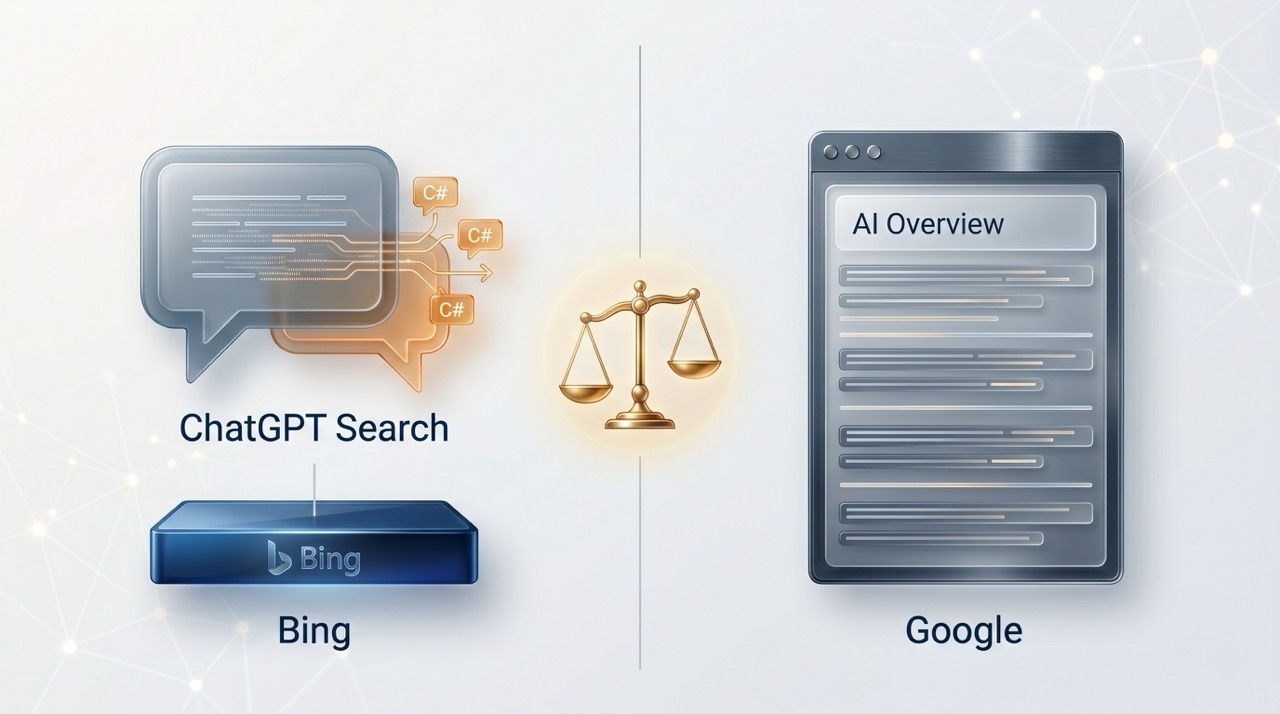
Index independence. Perplexity uses its own crawler (PerplexityBot) plus live web search. ChatGPT Search primarily uses Bing's index via OAI-SearchBot. Google AI Overview uses Google's index. This means a page can be cited by Perplexity but not ChatGPT, or vice versa – the source pools are genuinely different. Optimising for one does not guarantee the other.
Query type performance. For research-style questions where the user wants a synthesised answer with sources, Perplexity is strong. For conversational follow-up and creative tasks, ChatGPT has an edge. For navigational and local queries, Google's surface still dominates because of its index depth and integration with Maps, Shopping, and the broader Google ecosystem.
Freshness. Perplexity searches live and favours recent content heavily, which makes it strong for time-sensitive queries. This freshness preference is also a key citation signal, covered below.
The honest summary: Perplexity wins on source transparency and research depth, loses to Google on navigational and local queries, and trades with ChatGPT depending on whether the task is research (Perplexity) or conversation and creation (ChatGPT). For the technical and professional audience that has adopted Perplexity fastest, the source transparency is the deciding factor.
How Perplexity selects sources
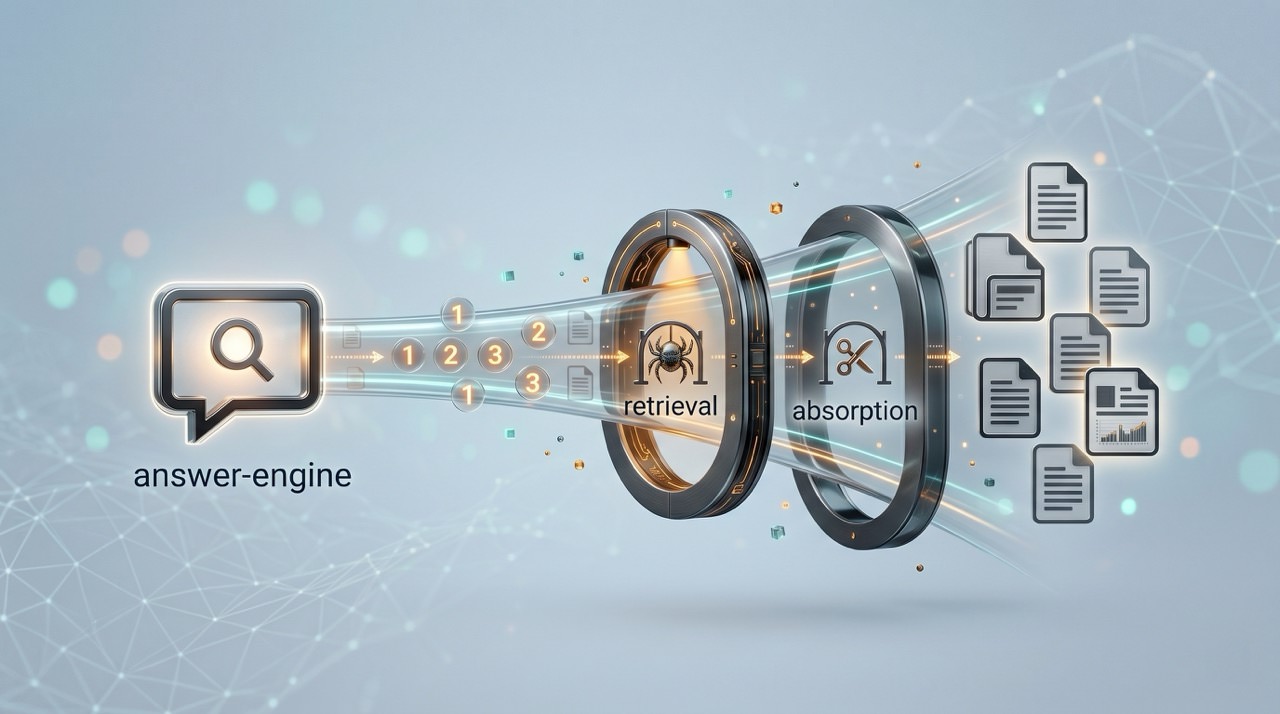
This is the mechanic that matters for SEO, and it is more specific than most coverage admits. Perplexity citation works through two separate gates, and passing one is not enough.
Gate 1: Retrieval selection. When a user submits a query, Perplexity runs a real-time search across its PerplexityBot index supplemented by live web search. It selects candidate sources based on relevance to the query, domain authority in traditional SEO terms, and freshness. If your page is not selected as a candidate at this stage, nothing else matters.
Gate 2: Answer absorption. From the selected candidates, Perplexity synthesises an answer. Your page's content has to be structured so that a clear, self-contained passage can be lifted into that synthesis. A page can be retrieved as a candidate but contribute nothing to the final answer because its content is buried in long paragraphs that don't extract cleanly.
Most brands optimise for one gate and ignore the other. Pages with strong authority pass retrieval but fail absorption because they're not extractable. Pages with clean extractable structure fail retrieval because the domain lacks authority signals. You need both.
Two crawlers handle the technical side. PerplexityBot is the indexing crawler that fetches and stores web content for the source pool – it respects robots.txt for text indexing. Perplexity-User is the real-time fetcher activated when a user's query requires visiting a page; because the request is user-initiated, this fetcher generally ignores robots.txt. PerplexityBot recrawls popular and frequently-updated sites every few days; less active sites are recrawled weekly or less often.
The 9 signals that get you cited by Perplexity
Across practitioner testing and Perplexity's own documentation, nine signals determine citation. They map to the two gates – the first three are prerequisites for retrieval, the rest improve absorption.
1. Crawl accessibility (the prerequisite)
If PerplexityBot cannot reach your page, no other signal matters. Check your robots.txt for an accidental block. The configuration to allow citation:
User-agent: PerplexityBot
Allow: /

User-agent: Perplexity-User
Allow: /
If you use a WAF or CDN, PerplexityBot's requests may be blocked by bot-mitigation rules. Perplexity publishes official JSON endpoints for its IP ranges – use them as the source of truth for your allowlist rather than guessing. This single technical issue is the most common reason pages are silently absent from Perplexity citations.
2. Public accessibility
Content behind a paywall, login wall, or geo-block typically cannot be cited because the crawler can't access the full page. If a page matters for AI citation, it has to be publicly readable without authentication. This is a real trade-off for subscription publishers, and one reason the Comet Plus publisher program exists.
3. Freshness with visible date stamps
Perplexity favours recent content heavily and exposes time-period filters that many queries implicitly invoke. A 2023 page that hasn't been updated competes poorly against a 2026 version of the same content. This does not mean republishing with a fake new date – it means updating the evidence, statistics, and examples when they go stale, and ensuring the dateModified property in your Article schema reflects the most recent meaningful update. Quarterly updates with visible date stamps suffice for evergreen content; trending topics need monthly review.
4. Self-contained, extractable passages
Because Perplexity stitches answers from multiple sources, it favours passages that make sense on their own. A clean answer placed directly under a relevant heading is far more likely to be quoted than the same point buried mid-paragraph. Write so that any single paragraph could be lifted out and still read as a complete answer to a specific question.
5. Question-answer structure
Pages organised around clear questions with direct answers map onto how users query Perplexity. Headings phrased as questions, followed by a direct one-to-two-sentence answer before elaboration, give Perplexity exactly the extractable unit it needs. This is the same structure that helps with Google AI Overview, which makes it efficient to optimise for both.
6. Domain authority signals
Perplexity evaluates source credibility before citing. Content from low-authority or unverifiable sources gets filtered out even when well-structured. The traditional SEO authority signals – quality backlinks, topical depth, site reputation – still feed this evaluation. GEO does not replace SEO authority; it adds an extraction layer on top of it.
7. Named author with credentials
Every page targeting Perplexity citations benefits from a named author with a bio that includes relevant credentials and professional context. Anonymous or generic content is a credibility disadvantage at the retrieval stage. Author markup and a real bio with verifiable expertise improve citation odds.
8. Explicit geographic and domain context
If your brand serves a specific market, make it explicit on the page. Vague geographic scope is a retrieval disadvantage when a query has regional intent. A page that clearly states the market, region, or context it covers gets selected more reliably for queries with that context.
9. Standalone proof blocks
The final absorption signal is about extractable evidence. Pages with clear definitions, labelled sections, quotable summary statements, and standalone data blocks contribute more to the generated answer than pages that bury their evidence. A statistic with its source on its own line, a definition in a single clean sentence, a labelled comparison – these are the units Perplexity pulls into answers.
A practical note on what does not work: paying for Perplexity Pro has zero effect on whether your brand gets cited. Citation selection is entirely organic. There is no paid placement in Perplexity answers as of 2026. Anyone claiming a subscription buys citation visibility is wrong.
How to actually use Perplexity
For the user side rather than the optimisation side, the features worth knowing.
Focus modes narrow the source pool. Academic restricts to scholarly sources, which is genuinely useful for research that needs peer-reviewed citations. Other focus options narrow to specific content types. Switching focus changes which sources Perplexity draws from, which directly affects answer quality for specialised queries.
Spaces are the feature most underused by casual users. For any ongoing research project – a competitive analysis, a literature review, a market study – a Space keeps the sources, files, and threads organised in one place across sessions. This is where Perplexity competes most directly with ChatGPT Projects.
Deep Research runs a longer multi-step research process and produces a more thorough report than standard search. The free tier includes a small daily allowance; Pro expands it. For questions that genuinely require synthesis across many sources, it is the mode to use.
Comet changes the interaction model. Instead of going to Perplexity and asking a question, the assistant lives in your browser and can answer about whatever page you're on. For research-heavy workflows, having the assistant in-page rather than in a separate tab is a meaningful efficiency gain.
Privacy and data retention
What Perplexity logs differs by tier. The free tier processes queries through auto-selected models, and the data handling follows the consumer privacy policy. Enterprise tiers add data controls, including options around retention and whether data is used for training.
For professional or sensitive research, the Enterprise data controls are the relevant tier – the consumer tiers do not offer the same guarantees. Anyone using Perplexity for client-confidential or regulated work should verify the data handling directly against current policy rather than assuming, particularly given the EU AI Act's General-Purpose AI obligations that take effect on August 2, 2026. As of mid-2026, Perplexity had no public compliance statement specific to those GPAI requirements, so European procurement for regulated workflows should verify compliance directly before deploying.
Costs and limits in 2026
The full pricing picture as of 2026:
- Free – permanent, with a limited daily allowance of Pro Searches and Deep Research queries, auto-selected Sonar model
- Pro – $20/month or $200/year, unlimited Pro Search, daily Deep Research allowance, Model Council
- Max – $200/month, unlimited Labs, Perplexity Computer, newest-model priority
- Education – $10/month, Pro features at a student rate
- Enterprise – from $40 per seat, data controls and admin features
- Comet browser – free on all platforms
- Comet Plus – $5/month standalone, included with Pro and Max
- Sonar API – usage-based pricing for developers building on Perplexity's search
For most individual users, the free tier is adequate for occasional research and Pro at $20/month is the right upgrade for sustained use. Max is only worth it for users who regularly hit Labs or Computer limits, or who want to consolidate multiple AI subscriptions into one platform.
FAQ
What is Perplexity AI?
Perplexity is an AI answer engine that searches the live web in real time, synthesises a direct answer to your question, and cites the sources it used. In 2026 it serves over 45 million monthly users and handles more than a billion queries a month. Unlike a traditional search engine that returns a list of links, Perplexity returns a synthesised answer with inline footnotes.
Is Perplexity better than Google?
For research-style questions where you want a synthesised, cited answer, Perplexity is often faster and more transparent than Google. For navigational queries, local search, and shopping, Google's index depth and ecosystem integration still win. They serve different needs rather than one strictly beating the other.
How much does Perplexity Pro cost?
Perplexity Pro is $20 per month or $200 per year. It unlocks unlimited Pro Search, a daily allowance of Deep Research queries, and the Model Council feature that routes queries through multiple frontier models. For sustained research use, it is the right tier for most people.
What is Perplexity Comet?
Comet is Perplexity's Chromium-based AI browser. It launched in July 2025 as a paid exclusive, went free worldwide in October 2025, and arrived on iOS and Android in March 2026. It puts an AI layer on every page – you can ask about what you're reading, summarise pages, and run agentic tasks like booking directly in the browser. It is free on all platforms.
How do I get my website cited by Perplexity?
Pass two gates. First, ensure PerplexityBot can crawl your page – check robots.txt and WAF rules. Second, structure content so clear, self-contained passages can be extracted into answers. The key signals are crawl accessibility, freshness with visible dates, question-answer structure, domain authority, named authors, and standalone extractable passages.
Does paying for Perplexity Pro help my brand get cited?
No. Perplexity Pro is a user subscription that affects your search experience, not which sources get cited. Citation selection is entirely organic, based on content quality, structure, and authority. There is no paid placement in Perplexity answers.
How many sources does Perplexity cite per answer?
Standard Perplexity answers include roughly five to eight citations. The exact number varies by query complexity and how many sources contribute meaningfully to the synthesised answer.
What is the difference between PerplexityBot and Perplexity-User?
PerplexityBot is the indexing crawler that fetches and stores web content for Perplexity's source pool, and it respects robots.txt for text indexing. Perplexity-User is the real-time fetcher activated when a user's query requires visiting a page; because it is user-initiated, it generally ignores robots.txt. Block PerplexityBot and you remove yourself from the citation pool.
Do I need to rank on Google to get cited by Perplexity?
Less than you do for Google's own AI Overview. Perplexity searches the live web and draws from a wider pool, so a well-structured, current page can be cited even without strong Google rankings. Authority still matters, but the dependence on Google ranking specifically is lower.
Is Perplexity good for academic research?
Yes, particularly with Academic focus mode, which restricts the source pool to scholarly sources. For research that needs peer-reviewed citations, this is one of Perplexity's strongest use cases. Verify the specific citations as you would with any tool.
How does Perplexity compare to ChatGPT Search?
Perplexity cites sources more consistently and uses its own crawler plus live search. ChatGPT Search primarily uses Bing's index. A page can be cited by one and not the other because the source pools differ. Perplexity has an edge on research transparency; ChatGPT has an edge on conversational and creative tasks.
What is Perplexity Spaces?
Spaces are persistent research workspaces where you organise sources, files, and threads around an ongoing project. They are Perplexity's equivalent to ChatGPT Projects and are the most useful feature for sustained, multi-session research.
How often does PerplexityBot recrawl my site?
Popular and frequently-updated sites are recrawled every few days. Less active sites are recrawled weekly or less frequently. Maintaining a regular publishing and update cadence increases crawl frequency, which helps fresh content get into the citation pool faster.
Can Perplexity cite content behind a paywall?
Generally no. Content behind a paywall, login wall, or geo-block can't be crawled, so it can't be cited. If a page is important for AI citation, it needs to be publicly accessible. The Comet Plus publisher program is Perplexity's mechanism for surfacing premium publisher content through a revenue-share arrangement instead.
What is the Model Council in Perplexity?
Model Council, launched February 5, 2026, is a Pro feature that routes your query through multiple frontier models, evaluates which is best suited for the specific question, and either selects the best response or synthesises across them. The point is that different models have different strengths, and routing matches the query to the right one.
Is Perplexity worth paying for?
For occasional research, the free tier is enough. For sustained daily research use, Pro at $20/month is worth it for unlimited Pro Search and Deep Research. Max at $200/month only makes sense for power users hitting Labs or Computer limits or consolidating multiple AI subscriptions.
Perplexity is the AI surface where citation is most achievable for well-structured content, because its source pool is wider than Google's and its dependence on traditional ranking is lower. The work is concrete: make sure PerplexityBot can reach your pages, keep your content fresh with visible dates, and structure it so clear passages extract cleanly into answers. For the broader picture of how AI search is reshaping what gets cited, the AI Overview guide covers Google's surface, and the best AI search engines comparison puts Perplexity in context against the full field.